

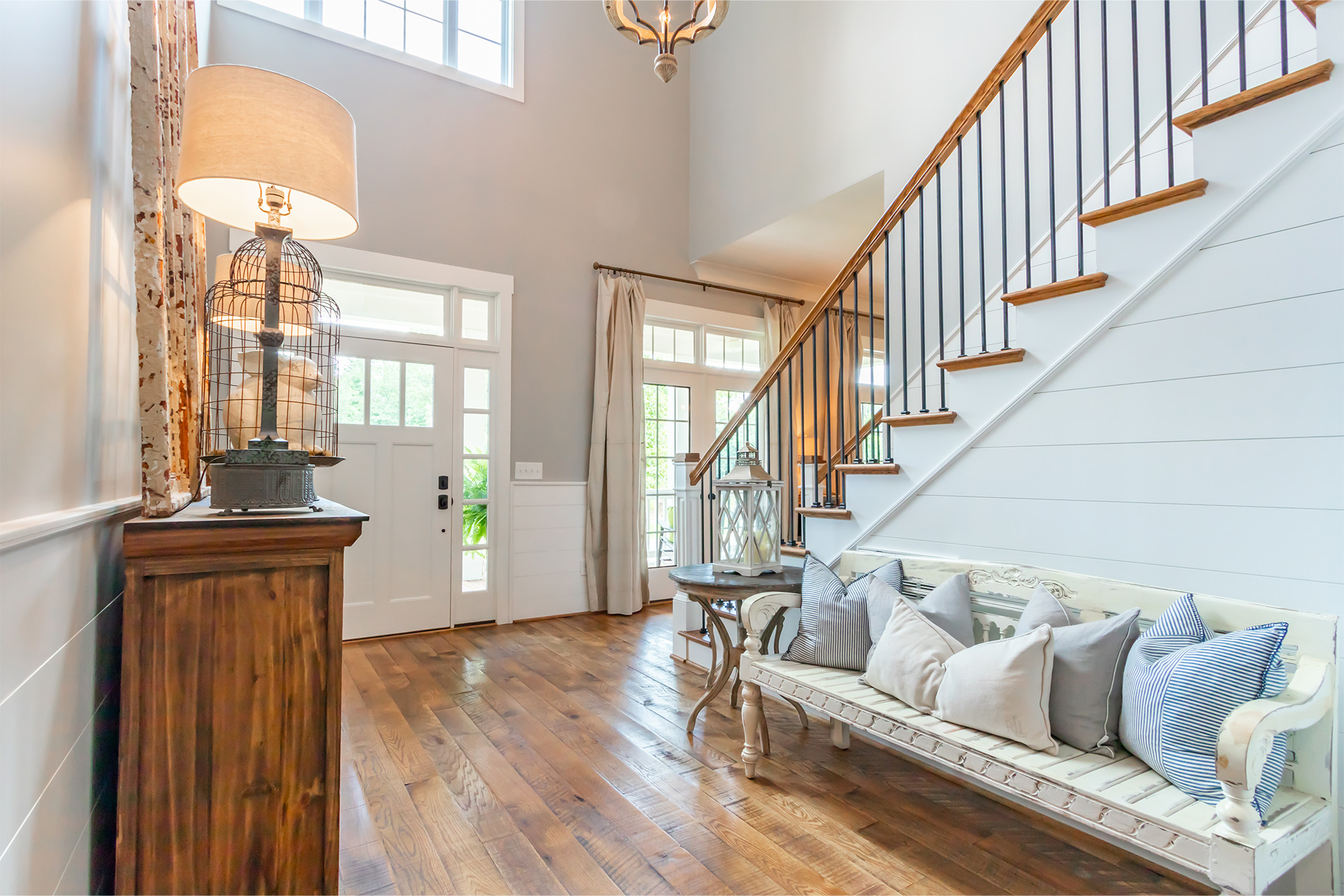
Hardwood flooring brings enduring warmth, elegance, and natural character to your home. When you treat your flooring as the fifth wall of your room, you create an opportunity to introduce rich texture, color, and authentic personality into your living space. In a multi-level townhome, your floors do more than support your daily steps. Your upstairs floor also serves as the ceiling directly above your main living area, home office, finished basement, or downstairs neighbors.
Multi-level townhomes across Douglassville and Wyomissing, PA, offer practical layouts, but multi-story floor plans present a distinct acoustic challenge. Hard surfaces naturally reflect and transmit sound energy. Without proper sound isolation, footsteps, dropped items, or active pets easily echo through the entire building. Installing high-performance acoustic underlayment allows you to enjoy genuine hardwood without sacrificing quiet comfort. At About All Floors, we help you cut through the noise of big-box retail stores to find the ideal sound isolation barrier tailored to your household, lifestyle, and local community standards.
What Is an Acoustic Underlayment for Hardwood Floors?
An acoustic underlayment is a specialized, resilient barrier installed directly between your subfloor and your hardwood planks. Its primary function is mechanical decoupling, which means breaking direct contact between your hard surface flooring and the rigid framing beneath it. By absorbing vibrational energy before it penetrates your structural floor joists, an acoustic underlayment prevents sound from radiating into rooms below.
Beyond dampening noise, premium underlayments provide thermal insulation and moisture protection. In our regional climate, four-season temperature swings and summer humidity cause natural wood to expand and contract. Choosing the right acoustic underlayment protects your hardwood investment against subfloor moisture while keeping your floors warmer underfoot during cold Pennsylvania winter mornings.
How Does Sound Travel Through Multi-Level Townhomes?
Sound travels through multi-story residences in two distinct forms: airborne sound and structure-borne impact sound. Understanding both types of noise helps you choose the right sound isolation strategy for your townhome layout.
Airborne sound travels through the air before vibrating off surfaces. Familiar examples include conversational speech, television audio, stereo systems, and barking dogs. When these sound waves hit an untreated floor, they cause the floor-ceiling assembly to vibrate, passing the noise downward.
Impact sound occurs through physical contact with your flooring. Foot traffic, sliding furniture, pet claws clicking across planks, and dropped household items generate vibrational energy that transfers directly into your subfloor and wall framing. Because hardwood is naturally rigid and dense, it acts as an acoustic transmitter. Without an effective dampening underlayment, impact vibrations travel downward with very little resistance.
Understanding Sound Ratings: What Are STC and IIC?
When shopping for acoustic underlayments, you will encounter two primary industry testing standards: Sound Transmission Class (STC) and Impact Insulation Class (IIC). Both metrics use a numerical scale where higher scores indicate superior sound reduction.
STC measures how effectively an entire floor-ceiling assembly blocks airborne sound like voices and television noise. A basic subfloor assembly without insulation often scores around STC 30 to 35, allowing audible speech to carry between levels. Adding a high-density acoustic underlayment elevates this rating to STC 50 or higher, turning normal conversation into an imperceptible murmur.
IIC measures how effectively an assembly absorbs structure-borne impact noise from footfalls and dropped objects. For multi-level townhomes, IIC is the most critical metric. The International Building Code (IBC) requires a minimum IIC rating of 50 for multi-family residential buildings. Many townhome communities and homeowners associations (HOAs) throughout Berks County and the Greater Reading area enforce higher requirements, often mandating IIC 55 or IIC 60 before approving hard-surface flooring replacements.
You should also look for Delta IIC (written as ΔIIC). While standard IIC rates the entire floor-ceiling assembly, Delta IIC measures the precise acoustic improvement that the underlayment adds to a bare concrete slab or standard wood subfloor on its own. A higher Delta IIC rating confirms that your underlayment provides substantial sound dampening.
Best Acoustic Underlayment Materials for Townhome Living
Every household has unique noise patterns, subfloor conditions, and installation requirements. Selecting the ideal acoustic underlayment depends on whether you install floating engineered planks or nail-down solid hardwood.
Natural Cork Underlayment
Natural cork is a proven, eco-friendly acoustic underlayment that provides exceptional impact sound absorption. Cork features a cellular structure with millions of microscopic air pockets per cubic inch. These air chambers absorb and disperse vibrational energy before it enters your subfloor framing.
Cork offers outstanding compressive strength, meaning it will not crush or lose elasticity under heavy furniture or years of foot traffic. It is naturally hypoallergenic and resistant to mold and mildew. Cork also adds natural thermal insulation, keeping your hardwood floors warm during freezing Pennsylvania winter months.
High-Density Recycled Rubber Underlayment
High-density recycled rubber underlayment delivers maximum acoustic mass. Because rubber is heavy, elastic, and dense, it excels at deadening low-frequency impact vibrations that lightweight foams cannot stop.
Rubber underlayment maintains its resilience indefinitely and will not break down over decades of foot traffic. If you have an active household with energetic kids, pets running down hallways, or an upper-floor exercise area, dense rubber underlayment offers superior sound isolation.
Dense Acoustic Felt and Closed-Cell Foam
Dense needle-punched acoustic felt is made from recycled textile fibers pressed into a sturdy, sound-absorbing pad. Felt absorbs ambient room noise, eliminates hollow clicking sounds, and creates a supportive cushion beneath floating engineered hardwood planks.
Many premium felt and closed-cell foam underlayments include integrated vapor barrier membranes with self-sealing tape edges. This built-in moisture protection blocks water vapor emissions from reaching your hardwood planks, saving installation time while protecting against seasonal humidity shifts.
Installation Techniques: Preventing Flanking Sound Paths
Even the highest-rated acoustic underlayment will underperform if your installation creates flanking sound paths. Flanking occurs when sound vibrations bypass your underlayment and travel through adjoining walls, baseboards, heating ducts, or rigid metal fasteners.
When installing floating engineered hardwood floors, our installers roll the underlayment across your entire subfloor and seal every seam securely. Leaving precise perimeter expansion gaps around every wall is critical. If your hardwood planks press tightly against drywall or baseboards, footsteps will transfer vibrations directly into your wall studs.
For glue-down hardwood installations, you need specialized acoustic underlayment rated for double-stick applications, or high-performance sound-dampening adhesives. Advanced urethane adhesives feature elastomeric polymers that absorb impact vibrations while bonding your planks securely to the subfloor. Our professional installers isolate baseboards and maintain strict acoustic separation across your entire floor plan.
Flooring for Daily Pennsylvania Life
Townhome living in Douglassville and Wyomissing, PA, requires flooring solutions that balance aesthetic beauty with everyday durability. From snowy boots tracking into entryways to humid summer days that alter indoor moisture levels, your floors face constant seasonal changes.
Pairing your hardwood with the right acoustic barrier delivers long-term peace of mind. You can enjoy the warmth and character of genuine hardwood in your upstairs bedrooms, home offices, and hallways without worrying about disturbing family members or neighbors below.
Plan Your Flooring Project With About All Floors
Upgrading your townhome flooring should be an inspiring, stress-free experience. At About All Floors, we offer a direct partnership from inspiration to installation. Our dedicated project specialists help you translate modern interior design into practical, affordable realities that complement your lifestyle and budget.
Ready to find floors built for your daily life? Visit either of our local showrooms in Douglassville or Wyomissing, PA, or give our team a call today to schedule your personalized design consultation and in-home flooring estimate.


